Is the AI boom running on debt? Here's what CoreWeave's own numbers say.
Every AI stock price assumes the buildout keeps getting funded. CoreWeave is the clearest test of that assumption, because it's the rare company in this space with a public debt stack, a public bond market, and a credit default swap market pricing its default risk in real time. None of that shows up in a stock chart.
Four debt facilities, $16.8 billion, since 2025
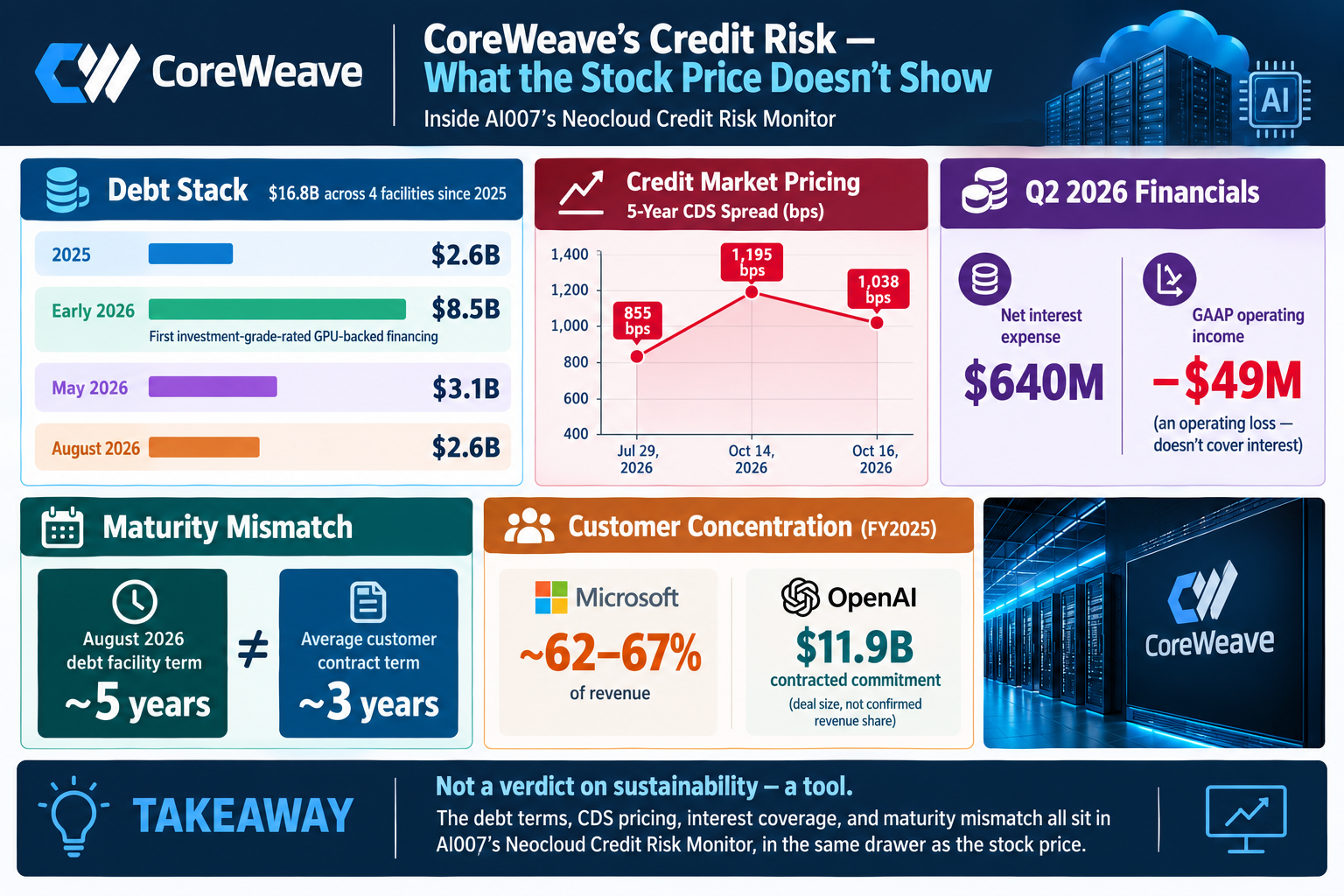
CoreWeave has raised GPU-backed debt four times in under two years: a $2.6 billion facility in 2025, an $8.5 billion facility in early 2026 (its first investment-grade-rated GPU-backed financing, a real milestone), a $3.1 billion facility that May, and a $2.6 billion facility in August. That's $16.8 billion in debt financing specifically to buy the hardware this buildout runs on, on top of whatever equity it's raised.
The credit market isn't pricing this the way the stock market is
CoreWeave's five-year CDS spread, the market's own price on the odds of default, sat at 855 basis points on July 29. By October 14 it had climbed to 1,195, before settling back to 1,038 two days later. The credit market moved on this company's risk independently of whatever the stock itself was doing on those same days.
The numbers behind that price action
CoreWeave's own Q2 2026 filing shows net interest expense of $640 million against a GAAP operating loss of $49 million. Operating income didn't cover interest expense that quarter; it was negative before interest even entered the picture.
There's also a maturity mismatch CoreWeave disclosed itself. The August facility runs roughly five years, against an average customer contract term of about three years. The debt backing the hardware is set to outlast the contracts currently paying for it, more than once over.
Where the revenue actually comes from
Microsoft accounted for roughly 62 to 67% of CoreWeave's FY2025 revenue (sources disagree on the exact figure). OpenAI has a separate $11.9 billion contracted commitment on top of that, though that's a deal size, not a confirmed share of current revenue. Concentration like that cuts two ways: it's about as reliable a customer as exists in this market, and it's also a dependency most companies would rather not carry.
Not a verdict, a tool
None of this says CoreWeave's financing is unsustainable. The 2027 wafer-fab-equipment and compute buildout is real, demand hasn't disappeared, and an investment-grade-rated debt facility backed by GPUs didn't happen because lenders think the business is broken. What it does say is that the stock price alone tells you almost nothing about any of it, the debt terms, the CDS pricing, the interest coverage, or the maturity mismatch.
That's what we built AI007's Neocloud Credit Risk Monitor for: CoreWeave's full debt stack, its CDS spread history, its interest coverage by quarter, and its customer concentration, sourced from SEC filings and credit markets and kept current each quarter, sitting in the same company drawer as the stock price. It's the kind of view that usually lives in a credit desk, not a retail app.
Want to see it yourself?
Launch App Free →